

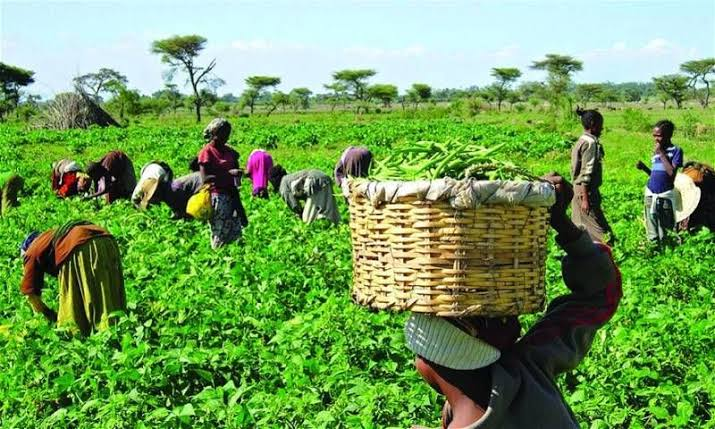
The Federal Government has launched emergency farm support for 4,000 smallholder farmers affected by the 2026 rainy-season floods in Ogun State. The intervention provides essential agricultural inputs to help farmers recover damaged farmlands, resume production and protect their livelihoods.
Implemented through the National Agricultural Development Fund (NADF), the programme targets 2,800 maize farmers and 1,200 rice farmers. Beneficiaries are expected to receive fertilisers, herbicides and pesticides under the Fund’s Agricultural Emergency Intervention in Enterprise Recovery for Flood-Affected Smallholder Farmers.
The NADF Executive Secretary and Chief Executive Officer, Mohammed Ibrahim, announced the initiative during its flag-off ceremony in Ogun State. He was represented by Olakunle Dabiri, Head of the Fund’s Mechanisation Unit.
According to Ibrahim, the intervention aims to reduce the impact of flood-related losses and prevent damaged farmlands from disrupting subsequent planting seasons.
Flooding Threatens Agricultural Production and Farmers’ Livelihoods
The 2026 rainy-season floods damaged farmlands and agricultural assets in affected communities across Ogun State. Consequently, many smallholder farmers face the risk of losing income and struggling to maintain their usual production levels.
Ibrahim stressed that timely assistance would help prevent these immediate losses from developing into longer-term agricultural challenges.
He explained that the intervention would focus on three major areas: needs assessment and beneficiary verification, emergency distribution of farm inputs, and climate-smart recovery measures.
The assessment process is being conducted in collaboration with state governments. It is designed to identify affected farmers, determine the extent of damage and ensure that support reaches verified beneficiaries.
In addition to distributing farm inputs, the programme will promote agricultural extension services, early-warning systems and capacity-building initiatives. These measures are expected to improve farmers’ preparedness for future climate-related emergencies.
NADF Sets Seven-Week Target for Farm Recovery Programme
The National Agricultural Development Fund expects to complete the intervention within seven weeks. The timeline is particularly important because delays in distributing agricultural inputs could cause farmers to miss critical planting periods.
To strengthen accountability, the Fund will deploy its digital monitoring and evaluation framework to track input distribution, monitor beneficiaries and assess recovery progress.
Ibrahim also disclosed that NADF would develop a comprehensive database of verified beneficiaries to improve transparency and ensure that the intervention reaches its intended recipients.
He noted that the programme’s success would not be measured solely by the quantity of inputs distributed. Instead, its impact would depend on how effectively affected farmers restore their farmlands, rebuild their livelihoods and secure future harvests.
Ogun Government Expands Agricultural Mechanisation
Ogun State Commissioner for Agriculture, Bolu Omotowo, welcomed the Federal Government’s intervention, describing it as support for the state’s efforts to improve agricultural productivity.
He disclosed that NADF had distributed more than 20,000 bags of fertiliser to farmers in the state about four months earlier, during the planting season.
Omotowo also highlighted the state government’s investment in agricultural mechanisation. According to him, Ogun State has provided eight tractors to its eight farm settlements.
The equipment supplied also includes tipping trailers, ploughs, harrows, maize planters and cassava planters.
These machines are expected to encourage mechanised farming, reduce dependence on traditional cultivation methods and improve agricultural output across the state.
However, the commissioner called on NADF and other development partners to expand future agricultural interventions beyond rice, maize and cassava. He specifically requested additional support for cotton farmers, highlighting the crop’s importance to agricultural production in Ogun State.
Flood Recovery Remains Important to Nigeria’s Food Security
The emergency intervention in Ogun State forms part of wider efforts to protect agricultural production from flooding and other climate-related emergencies.
Flood damage often extends beyond the immediate destruction of crops. It can affect productive farmland, agricultural infrastructure, household income and farmers’ ability to finance subsequent planting seasons.
For Nigeria, prolonged disruptions to smallholder farming can also affect food availability and agricultural supply chains. Therefore, helping affected farmers return to production remains important to sustaining domestic food output.
However, the effectiveness of the FG farm support for Ogun farmers will depend on several factors. These include timely distribution of promised inputs, accurate beneficiary selection and the ability of farmers to restore their damaged farmlands.
The NADF’s seven-week implementation target and digital monitoring framework will therefore play an important role in measuring the programme’s impact.
Ultimately, the success of the intervention will depend on whether it helps affected farmers resume cultivation, restore their livelihoods and improve their prospects for future harvests.












Leave a comment