

A Review of amu nnadi’s The Love Canticles
By Onyemuche Anele Ejesu
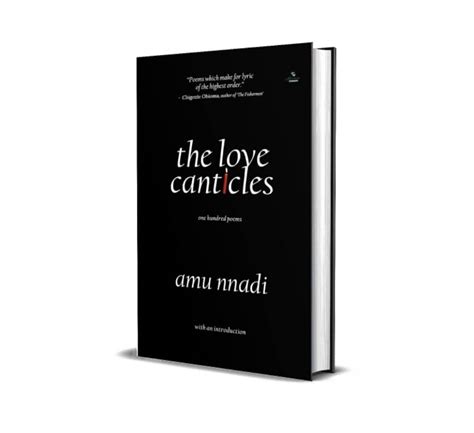
Two poetic traditions, place poetry and love poetry, interact in amu nnadi’s latest collection of poems, The Love Canticles. But that is not the only way in which the collection is both significant and revolutionary. I believe its most revolutionary bent is to be found in the way it solicits the African literary canon. I am using the word solicit in its original etymological meaning of to disturb, to shake, to agitate. Why does the African literary canon need the kind of agitation that this collection, by its very nature, continues? I say ‘continues’ because there are palpable signs of this kind of agitation in the works of a handful of vibrant young African voices like Safia Elhilo, Clifton Gachagua, Inua Ellam, JK Anowe, etc., in spite of the peculiarities of their works.
The answer to the question asked above is inherent in the way African literature has been defined since the time of its modern pioneers, in the requirement of social relevance as the authentic mode of being for any work that seeks a decent place in the African literary canon. African literature, for a long time, has leaned towards the public, towards what could be described as the collective experiences of the African people. Tanure Ojaide panders to the same thinking when he writes in his ‘The Way We Sing and Tell: Defining Modern African Poetic Aesthetics’ that:
The aesthetics of any art form tend to be conditioned by the total experience of the people who practice it. The people’s experience involves their culture and history. This aesthetic condition is expected since that very art is a product of a specific culture. A people who have had unique historical experiences focus the themes of their art works on what gives them an affirmation of their lives.
Armed with this kind of orientation, many teachers of African literature quite often screen any new work for what could suffice as the ‘unique historical experiences’ of Africa or a concern for what the critic, Romanus Egudu, calls ‘the African predicament’. There is thus little or no room for the interrogation and discussion of poetic works that project private experiences, works that are radically faithful to the lyric-hood of the lyric form, poems in which the poets appear to be saying: that my experiences are not public enough for you does not mean they are not valid.
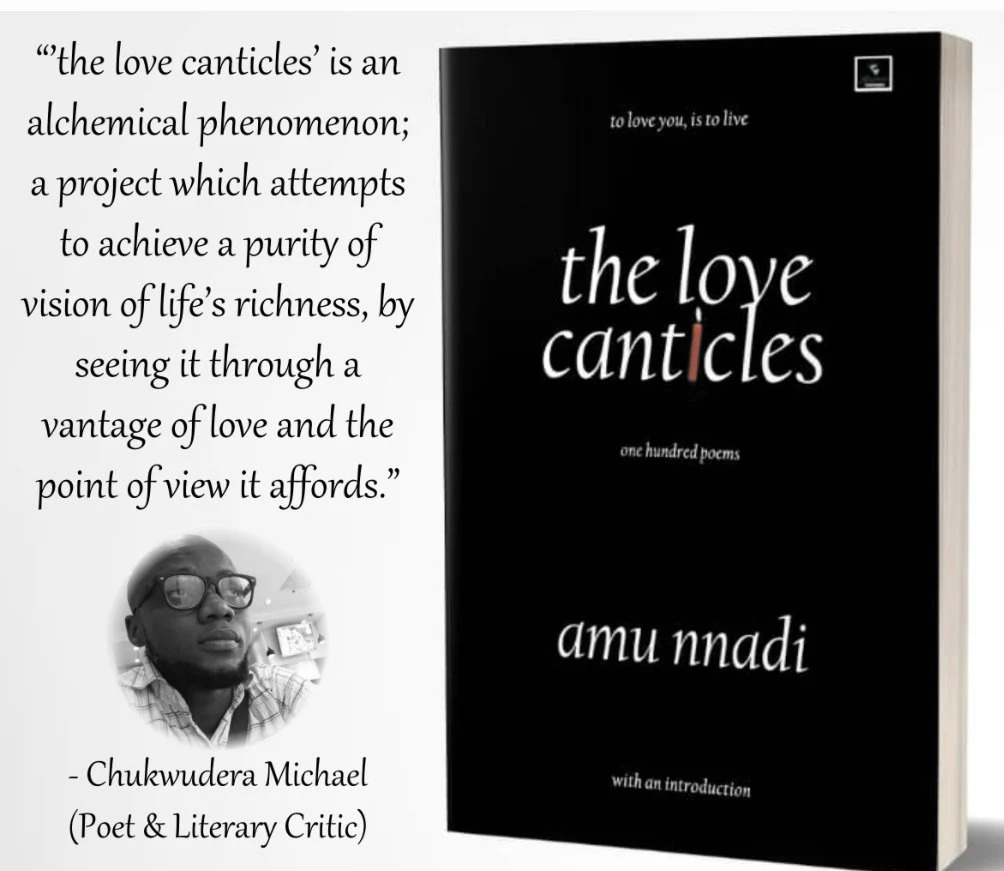
Poetry is the most private form of the literary art, particularly the lyric form of poetry. It is the same sentiment that critic Northrop Frye expresses when he writes that ‘the lyric is the genre in which the poet, like the ironic writer, turns his back on his audience’. In amu nnadi’s poetry, the lyric form self-actualizes, not only in terms of its primordial association with music, but particularly in terms of its significant reputation as the most deeply personal of all kinds of poetry.
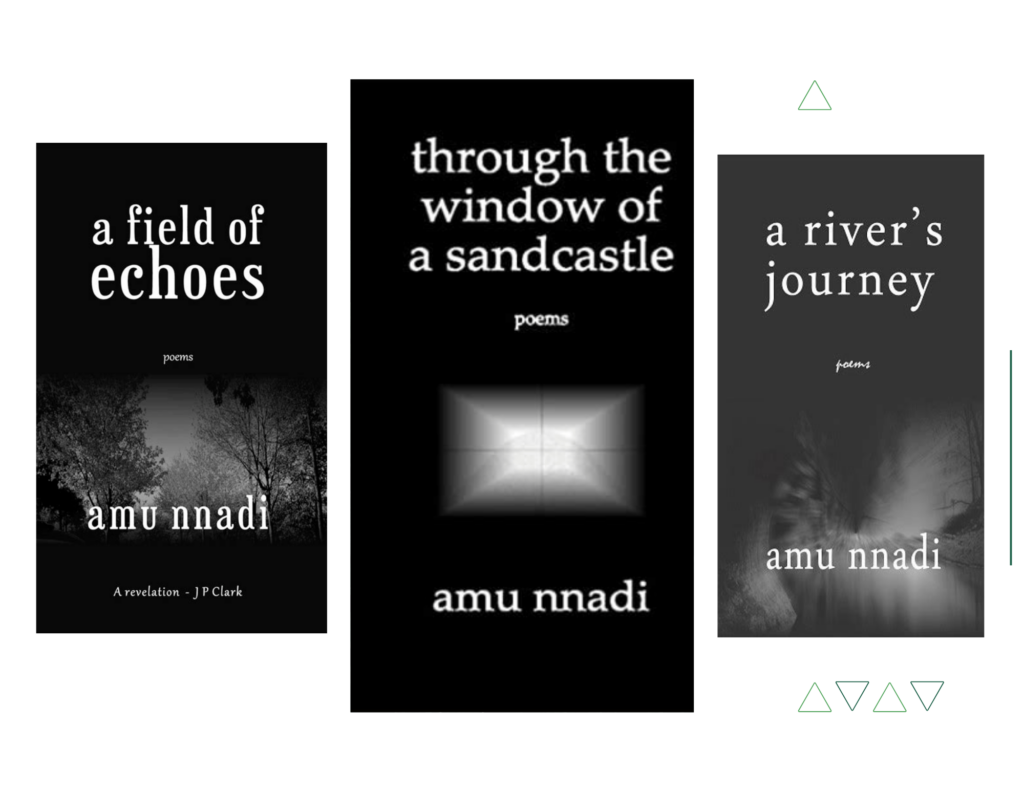
What we encounter in the lyrics in this new collection is a consciousness bewitched by love and place. Divided into five parts, it is a collection about the love of place and the place of love. Even though much attention has not been given to the discussion of ‘topo-poetics’ in African poetry, place poetry is not new in Africa. One of the earliest examples is J.P. Clark’s ‘Ibadan’. There are recent examples in Eriata Orhibabor’s Abuja na Kpangba and Afam Akeh’s Letter Home and Biafran Nights. However, there is something deeply enchanting about the place poems in The Love Canticles, something almost spiritual. And the same thing could be said of the love poems. I shall come back to the question of the spirituality later.
Whether it is ‘encountering athens’, ‘athens’, ‘greece’, and ‘santorini’, we perceive the places in these poems through the eyes of the poet. We follow the poet as he first encounters these places, armed with his experience of previous places and the vicarious experience of the new place, or what the poet calls ‘crumbs of an ache honed in books’. We follow the poet as his senses, by virtue of this baggage of experiences, begin to identify and seek out continuities and discontinuities, similarities and dissimilarities. We appreciate the curious eloquence of these places as they speak about their histories, victories, tragedies, beauties and enchantments.
And there is a Symbolist feel about the poems in the collection. I am referring to that quality of activating the inner life of things. Things, places and objects in amu nnadi’s poetry acquire surplus value. The poems cut beyond mere matter to the very soul of things, stretching the imagination and giving us heightened experiences of the things, places and moods they describe and evoke. We perceive the transcendental value of things, of milkshakes, emojis and letters, of foods, minutes and opening prayers. Poem after poem, we are moved, from place to place and from mood to mood, until we are filled with a cumulated sense and essence. For instance, in ‘just a few nights’, one appreciates the enduring longevity of fixed experiences. Experiences limited by time take on timeless significance, because of the depth of passion and the sincerity of the corporeal communion. This is what good poetry should do to us, to disclose the ‘more than’ value of ordinary things and experiences, to make us perceive the beingness of beings and the whatness of things. So, it seems then, that the speaker in one of the poems is addressing us when he implores: ‘look ahead, look inwards… look this way’.
The other tradition that gains full expression in this volume is love poetry. As with place poetry, it has not been given adequate critical attention, even though African poets have written love poems of great and enduring worth. No doubt, the marginalization of love poetry in African critical enterprise is engendered by the anxiety of social relevance or the lure of the political. It is not surprising then that the most popular African love poems in twentieth century African poetry (that is the love poems that made it to twentieth century African poetry anthologies) are those with political background. I am thinking of the love poetry of Antonio Jacinto and Dennis Brutus, as well as Leopold Sedar Senghor’s Negritude love poems. It is the same reality that Frank M. Chipasula has aptly summarized:
Despite these viable traditions of love poetry in Africa, contemporary written African literature has so entrenched overtly political protest poetry that one actually expects it from an African poet. The tragic consequence has been the stagnation and predictability of contemporary African poetry. All the same, a few seemingly political poets have also crafted memorable verses fusing politics and love.
In choosing a path not often acknowledged, amu nnadi and other contemporary poets who write love lyrics are shaking the canon; they are making a case for the place of love in African poetry canon.
It must be said that even though a good chunk of the poems in the collection are love poems, this does not imply a sort of boring sentimental singularity. Love itself is a complex phenomenon, a sequence dotted by a variety of feelings: pain, angst, desire, melancholy, ecstasy, emptiness, sadness and longing. Taken together, therefore, these love poems project a rich tapestry of emotions, addressing themselves to a variety of romantic inclinations and experiences, imagined and lived. When the mesmerized lover in the poem ‘je t’aime’ says ‘there are countless ways to declare: i love you’, he appears to be hinting at a major project of this work. The very success of that project is a testament to the fascinating fecundity of amu nnadi’s creative imagination. How else does one describe and interpret the poet’s ability to describe, render and evoke this timeless emotion called love in more than six dozen poems without boring the reader? Yes, poetry thrives largely through what Northrop Frye calls ‘the rhythm of association’. But the ability to convey meanings and feelings through the association of one thing with a truckload of various other things, in a way that is fresh, seamless and natural, is a testimony to a commendable imaginative depth. The poet’s ability to make us, through a variety of associations, to taste love, smell love, see love and touch love, his ability to activate the full range of our senses of perception in the experiencing of love, is a rare quality found only in the most sentient of poets. And it is through this fecund variability of images that the poems in the collection enlighten our imagination, deepen our understanding, touch our senses and enrich our own experiences.
I have already hinted at the issue of spirituality in The Love Canticles. For instance, the poem ‘confession’ is replete with religious images and nuances. The speaker in the poem declares:
and, again, tightly, i embrace you
to brand on you love’s scriptures
so when my sermons imprint you
our hearts say amen in every beat
This poem apprehends the bodily communion of lovers as some kind of deeply spiritual phenomenon, a sincere corporeal worship of spiritual significance. Worship is nothing but spiritual contact. The poem ‘confession’ (as well as the poem ‘worship’) seems to project the truth of the worship of bodily contact. As if to strengthen this notion of the bodily contact of lovers as sincere worship, the speaker, through the words ‘my love will run unbound/flood of spirit and truth’, evokes the words of Christ in John 4: 23: that ‘the time is coming, indeed it is here now, when true worshippers will worship the Father in spirit and in truth.’ Thus, the speaker is a worshipper, in spirit and in truth. But beyond overt references to biblical and religious phenomena, the question of spirituality in the collection may be explored within the subtle linguistic nuances of the poems. There is a hymnal or Psalmist feel about some of the poems. Take, for instance, the poems, ‘fasten, now, upon me’, and ‘altar call’. They read like Psalms of love.

However, there are questions the readers would have to come to terms with by themselves. Can what we find in the volume be comfortably christened the spiritualization of the secular? Or is it the reaffirmation of an ancient truth: that love is divine, love is spiritual? Or perhaps the religious and biblical images are the products of the innocent influences from the poet’s Christian background. Whatever be one’s inclination in these arguments, one cannot belie the immanence of the spiritual.
It is also significant to note that the poems in the collection are not stuck in the past. The range of associations made shows a keen awareness of our world, our ICT world, our world of selfies and iPhones, our world of emojis and text-messaging, our world of qwerty and control, delete and paste. Our world of cocktails, black coffee and an elevated taste of tongue and mind.
To conclude, it is important to understand the interaction of two traditions beyond just the distinct immanence of love poetics and topo-poetics. This interaction plays out in the consciousness that drives some of the poems. For instance, in the poem ‘my earth’, we find that Brutus-like reality where land and love exchange identities to the point that they become indistinguishable from each other. A similar thing is afoot in the poem ‘cities’, where we read:
as a minstrel, i load my luggage
of longings, and seek you, so i may visit
life’s best vistas, ah! exotic earth of love
The poems are not just about places and loves. They are in themselves created places and loves, so that the speaker in one of the poems speaks of ‘this lost being who crafts you into being’. To follow the poet in this journey, crafting loves and places into being, is to venture into an enterprise with plenty returns.












Leave a comment