

By Chibuzor Alli
The Federal Government will receive its first batch of 500 Compressed Natural Gas stations by the end of October as it expands CNG infrastructure across Nigeria.
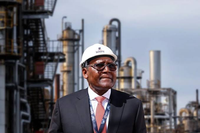
Executive Chairman of the Presidential Compressed Natural Gas Initiative, Ismael Ahmed, disclosed this in a chat with Sunday PUNCH on Saturday, saying another 500 stations would subsequently be ordered.
The move will bring the total number of CNG stations being procured to 1,000 as the government seeks to expand access to cheaper fuel and reduce transportation costs.
The development follows President Bola Tinubu’s directive in August for an additional 500 CNG refuelling stations nationwide, alongside 500 stations previously ordered by the Midstream and Downstream Gas Infrastructure Fund.
Tinubu said the expansion was aimed at helping Nigerians benefit from lower transportation costs, particularly for intra-state travel.
Ahmed said the first batch of 500 stations had already been ordered, adding that their deployment involved construction, transportation, installation and connection.
“There were already 500 stations that were ordered early, and in October the first batch would come in. In his (Tinubu’s) commitment to the governors, he said he would order another 500 added to the other 500 already, making it 1,000 in total.”
CNG stations to be deployed based on demand
Ahmed explained that the stations could not be deployed immediately after being ordered because of the processes involved in establishing them.
“Filling stations are not something you order today and get it tomorrow. It has to be built, it has to be brought in, and it has to be installed and connected. The process has begun. The first batch will be at the end of October.”
He said the government would prioritise locations with high demand for CNG, adding that it was profiling the country to determine areas requiring more stations.
“Wherever there is demand, we will take it. For now, the stations are coming in, and we are profiling the whole country. We already have many stations all across the country, but there are places where there is more demand than others, so it is where the demand is that is where we will push it.”
He stressed that the deployment would be based on economic considerations, including the number of vehicles and traffic in an area, rather than political considerations.
“It is not a political decision; it is an economic decision. So you can’t just say, ‘Go and put it in this village when there are no cars there.’ So you have to check the traffic, the cars; these are things to be taken into consideration.”
According to Ahmed, the government is profiling several locations across the country.
“We are looking all over the country. Lagos, Kano, Abuja, Portharcourt, Zamfara, Borno, Enugu, Anambra, Lafia.”
Abuja has 26 operational CNG stations
The PCNGI chairman said Abuja currently has 26 operational gas stations, making it the location with the highest number of such stations.
“There are 26 operational gas stations in Abuja. It is the highest in terms of gas stations. NNPC alone has about four, Nipco has about three.”
However, he identified land availability as a major challenge to establishing additional CNG stations in the Federal Capital Territory.
“The problem with Abuja is the land that will accommodate the station. So many people are interested in opening gas stations, but getting the land is a problem.”
Ahmed said gas was available across the country, but more stations were needed to improve access to CNG.
“Everywhere there is gas, but we need more stations, and we are working on it.”
FG targets lower transport costs
Tinubu had earlier revealed that the Federal Government was investing in conversion centres and refuelling infrastructure as part of efforts to expand CNG use and reduce transport costs.
He stated that a vehicle running on CNG could spend 60 to 80 per cent less on fuel than one running on petrol, with the government targeting lower transport fares from October 1.
In May, Tinubu commissioned four CNG infrastructure projects in Lagos, Abuja and Owerri, including a high-capacity CNG daughter booster station in Jahi, Abuja.
The projects formed part of the Federal Government’s broader push to expand domestic gas utilisation and provide alternatives to petrol.
The State House said the initiative was also designed to reduce transport costs and accelerate Nigeria’s transition to cleaner fuels.









Leave a comment