

I am reminded of the Olúgbọ́n and Arẹ̀sà in the Yorùbá hortatory discourse. Whoever they were, these anonymous figures have etched their names in the resonance of idealistic necessities. The rhetoric about what they experienced and how they went about salvaging their vulnerable lots strikes as a course of social re-engineering. In the course of diagnosing the failures of contemporary interpersonal relationships, we cannot deny the ultimate function of art-inspired conversations.
Excuse my French but one has got to be scientific, you know. The substance of our common mess is not in itself messy: something hangs about us in a weave of intra and interpersonal struggles. The tides come and go like a stillborn. The anxiety that thus attends our condition is a shared experience. We would rather repress our resentment or express our sentiment as sheer taciturnity at the way of the world. But if we do not talk these things out, how shall we identify the problem much less devise a means to absolve ourselves?
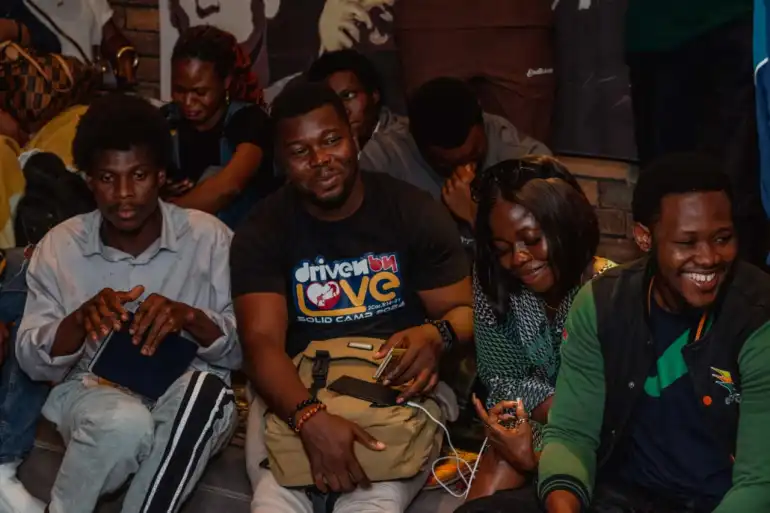
Griots and Bards (GAB) is a community of creatives, and industry maestros; experts, and ranking figures from several compartments of socio-economic configuration who hold an every-last-Thursday meeting to teach Africa the clamant demands of traditional way-outs to achieve harmony in a world clobbered by the terrible outrage of complementary life implosions. That description sounds cumbersome, yes. But it is suited to the style and practice of this noble gathering. However, to accommodate all and sundry, GAB is a community of industry meet ups and creatives who gather at Rap Joint, Lagos in one little corner of Ikoyi every last Thursday to pool opinions together on the way to lift our waning spirit of camaraderie. Specifically, GABites find a debative niche in the affairs that concern us as emotionally cloned species.
“GAB teaches us that woke culture is not the destination of societal transition. This explains why and how the topics are culled from the observable awkwardness of the new normal. As our world advances, we ask ourselves whether the changes gear towards progress or everything simply regresses.”
What is then African about this modest gathering of thinking heads? It is in the style and content. For the former, I am particular about the setting (temporal and spatial). GAB is a village square gathering. And by implication, it incorporates, in its inspiratorial essence, the nativisation of addressing oneself to the elder’s rhetoric. For context, it adapts itself to the riddle of a moonlight story, encouraging listeners to explore the metaphors of flora and fauna. In a similar vein, GABites take adventures into the explorative functions of social relationships by detours of personal encounters and experiences, knowledge-based responses, and contextual exemplifications of viable perspectives. And for the latter, GAB tends to satirise the shortcomings of contemporary society. The fact is not foreign to us that life has become so mechanical; we are very much in need of harmony and balance with Nature. So, when on a regular GAB day, the spirit of conversation chooses say romance as the talking point, rest assured geniuses of the thinking heads will unearth the clog of everyday experiences. Or when the muse airs the room with the state of any cultural hydra, rest assured there is some propinquity in what we regard as the failure of modernity.
GAB teaches us that woke culture is not the destination of societal transition. This explains why and how the topics are culled from the observable awkwardness of the new normal. As our world advances, we ask ourselves whether the changes gear towards progress or everything simply regresses. Thus, GAB gathers like-minded individuals to convert their responses to the options for development in the areas that have recreated us beyond the recognition of communal decorum.
The conundrum we face today is scientific. And without the lessons we learn from an initiative like GAB, many will escape into some Look-Back-in-Anger architecture of mental self medication. In fact, GAB bridges the gap we probably choose to not criticise in the real sense of its shortcoming: media correspondences. As it is said, face to face is better than a thousand letters. Today, we live lives of the mind more than before; we exist almost in the imagination of the consequences of our common struggles. Until we talk things out, we may remain in the same condition that is only accentuated by the illusion of media fraternities. At that rate, GAB teaches us that there is the indisputable need to ‘touch’ one another and lift our spirits in the security of a concentrated space where we are open to analyse and devise problems and solutions respectively.
On a much wider scope, I think there is something about contemporary society that alludes to the idea of half-corpses (courtesy of D.H. Lawrence’s Lady Chatterley’s Lover), as even found in the psychological reactions to the effect of political intrigues. Of course, we cannot divorce the superintendence of politics from the most basic personal implosion. Even if this is no ground for political debates, the undertone lingers; and without zooming in on it, the heads are able to wheel their takes into the conclusive model of individual homecoming. In this instance, GAB is beginning to clone an international debate platform. The evidence there is di-faceted. One, the content of the talks is as relevant and engaging as it is concerning. Even an introvert can feel some vibration and/or reverberations of their unspoken thoughts. And what do we say of such conversations that both speak for the taciturn and advocate for the garrulous (no pun intended)? Representative discussion, shall we say. Two, the kind of minds it brings together: the journalist, the engineer, the doctor, the teacher, the tech savvy, the lawyer, entrepreneurs – experts from all walks of life – by extension, and sundry experiences.
One recent gathering illustrates the practical energy of this conversational culture. At the February meeting of Griots and Bards held at RapJoint, participants tackled the theme, “Love: The Substance of Sacrifice.” Moderated by Habeeb Ajijola, the discussion moved beyond romantic clichés to examine love as intention, duty and responsibility. Contributors from different professional backgrounds debated how far sacrifice should go and where personal boundaries must intervene to prevent self-abandonment. What unfolded was less a search for definitive answers than a communal probing of the moral anxieties that define contemporary relationships. In that modest Ikoyi corner, the village-square ethos that GAB attempts to revive became vividly apparent.
To conclude, I would say that GAB is a metaphor of a kind. It serves as a generational bridge between the therapeutic engagements of primitive communities and their industrialised counterparts where individual lives are broken in subtle ways that consequently polarise the whole component of existence. One should be in that space once every three months, at least. The familiarity of human predicament is the substance of all sympathetic actions geared towards creative conditions of growth and sustainability.
Image credit: The lagos Review











Leave a comment