

Bayo Adegbite
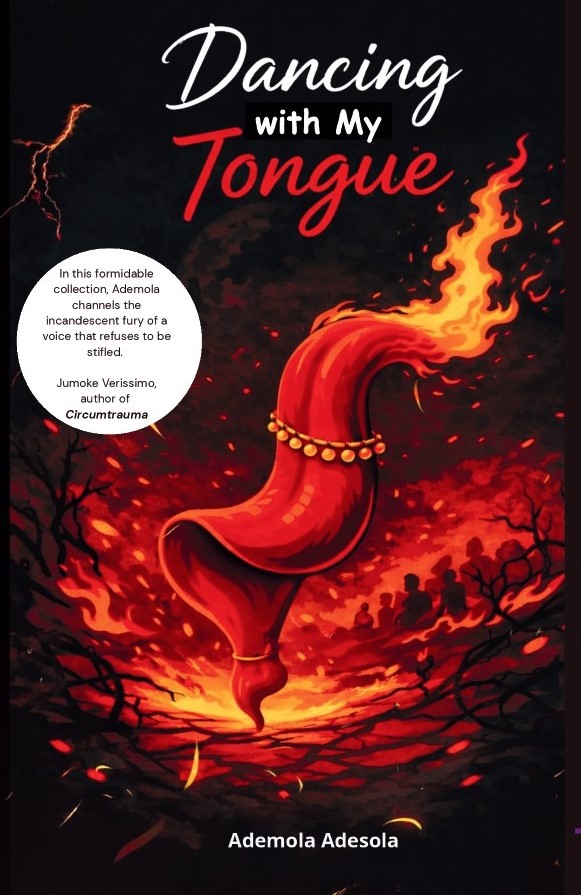
What do you do when your home as you have known it collapses around you? What will you do when all the political, social, religious institutions, even the academia ( that is supposed to be the bastion of knowledge against crude politics of uncivilized leaders) who by virtue of their place in that society are supposed to guide against that collapse are among those who engineered the collapse, and are feeding fat off the ruins? What do you do when as a result of that collapse you find yourself isolated in a foreign land, like a fish out of the water, and you have to endure discrimination and alienation simply because you are a different race or ethnicity?
Tolulope Ojuola, himself a Nigerian essayist, and literary scholar, in the diaspora believes that what an emigrant in that case usually does is to create a bridge from their past to their present through memory. This is exactly what Ademola Adesola has attempted to do in “Dancing with My Tongue”. To Adesola, it is literature that can best articulate his struggles to escape a collapsing home, resilience as a stranger in a foreign land, and his evolving identities as a diasporan. It is therefore unsurprising that he says in “Dancing with My Tongue” the poem for which the collection is named:
“Experiences make my tongue pulsate
About affairs on
continents alike and unlike
that tease and test my soul
…
The musical moves of my tongue buoy and boil the mind
They wax lyrical about times past
They waltz in recognition of times now
They wail and warn about possible tomorrows.”
As is typical of works like the collection in which migration represents an escape from the socio-economic constraints of Nigeria, but that escape in turn exposes the writer to a new form of alienation in a foreign land. The immediate emotion is anger. As it obtains in works such as Wole Soyinka’s “Telephone Conversations”, Buchi Emecheta’s Second-Class Citizen and more subtly but still palpable in Chimamanda Adichie’s Americanah. The poet persona spares no one from his anger, all the political, social, religious institutions who have played a role in Nigeria’s collapse, all come in for a tongue lashing. The author, himself an academic, unsurprising reserves some of his harshest tongue whippings for the academia. In “Mind Murderers” he says:
“University with Unitary thinking
…University without Universal knowledge
University without the philosopher’s stone
University without tested hands….”
Even the common people themselves who prefer to play the ostrich instead of fighting to save their future are not spared from the poet’s anger. In A People Afflicted with Hope, he says:
A People Afflicted with Hope Antagonize un-trending alternatives
A people afflicted with hope celebrate microscopic dividends
A people afflicted with hope normalize unfreedoms
A people Afflicted with hope genuflect to their afflictions
That anger then progresses from the Nigeria which he has left behind to the west which he currently lives, he criticizes the American hegemony which is represented by US President Donald Trump, with his actions in Gaza in particular coming under focus. This racism, to the poet, covers issues ranging from the personal microaggressions, suffered by the poet, to macro issues of race in Canada and America, to the wider issues of geopolitical aggressions such as the war in Gaza.
One cannot say if it is intended or not, but if there is ever a question on which popular writer this work is most similar to, it is difficult to look past the works of Wole Soyinka. The collection’s criticism of Donald Trump, (which interestingly enough is actually the main reason Soyinka himself is on a self-imposed ban from the US), is also perhaps one of the more overt ways in which the subtle similarities reflect. With Adesola’s anger at both the society he has left behind and the one that he finds himself in; his deployment of irony and sarcasm; his bitter and irreverent lampooning of the academia; and his satirizing of religious institutions; the comparisons become more and more glaring. Again, it is worth noting that Soyinka is perhaps one of the most popular African literary satirists so having an African literary satirist work be inspired by him is unsurprising, not to mention a testament to the literary and scholarly depth of such a writer.
In all the sarcasm and anger that Adesola expresses in Dancing with My Tongue, it is pleasing to see that he remains conscious of the medium he is expressing his message in. It is easy to see that as a literary scholar, the poet understands the importance of poetic structure and literary devices in bringing out the beauty of poetry regardless of theme. The poems are replete with similes, metaphors, alliterations, parallelisms, making them not just mediums of passing the author’s message but true poetry that melodious to chant, and read.
For all good points of the work, one cannot help but get drawn to the love poems in the collection. Like an improperly worn tie or the wrong color of shoes, the poems are unfit for the general tone and message of the work. Poems like “I am a Woman” and “Take my Cum” are particularly jarring in how thematically inappropriate they are in the collection. Not only this the poet does a particular bad job of linking them to the overall theme of the collection, leaving the reader wondering whether he left them there solely for the purpose of political correctness or in an attempt to appeal to a particular audience. If one were a conspiracy theorist, one would accuse the poet of pandering. Is it a case of just an error of omission, or is it the kind of politically correct pandering that has become a side effect of diaspora writing especially in Western countries nowadays. One suspects that debate would be on for a while yet.
Adesola Ademola’s “Dancing with My Tongue” is a unique exploration of identity, memory and alienation from someone who has experienced both the best and the worst of both Nigeria and diaspora. His sarcastic wit, ironic humor and his dexterous deployment of satire, is reminiscent of Soyinka in his NADECO days. More importantly his consciousness of the medium that he is using to deliver his message regardless of his tone and themes is why the work can rightfully take its place among the rich tapestry of narratives that define the diasporic experience and contribute to the global literary discourse on identity and belonging.












Leave a comment